Leasing Momentum In India's High-Street Retail, Destination Malls: What Brands Are Looking For In 2026
A CBRE report noted that retail leasing in Delhi-NCR jumped by about 25% in 2025. Fashion and apparel brands were the major contributors, accounting for 35% of leasing activity.
India’s retail sector is entering a distinctly mature phase. After a sharp post-pandemic rebound driven by pent-up demand, the sector is now witnessing a more calibrated and quality-led recovery. Consumption has shifted from being purely transactional to experience-oriented, with shoppers seeking destinations that blend retail, leisure, food, and community engagement. As a result, high-street formats and destination malls are being reimagined as lifestyle ecosystems rather than mere shopping hubs.
Against this backdrop, 2026 is emerging as a watershed year for retail real estate. Brands are becoming increasingly discerning, favouring hybrid formats that integrate physical stores with digital touchpoints, premium design, and flexible layouts. Location quality, footfall intelligence, and the ability to deliver immersive experiences are now central to leasing decisions, signalling a decisive shift towards more sustainable, experience-led retail growth.
A CBRE report noted that retail leasing in Delhi-NCR jumped by about 25% in 2025. Fashion and apparel brands were the major contributors, accounting for 35% of leasing activity. The remaining share was occupied by food and beverage operators and other lifestyle retailers.
Meanwhile, data from Cushman & Wakefield showed that retail leasing in Delhi-NCR stood at 1.03 million sq. ft. in Q4 2025—an increase of 100% quarter-on-quarter and 4.5 times on a year-on-year basis. Gurugram led overall retail leasing during Q4 2025 with a 63% share, followed by Delhi (22%) and Noida (15%). Malls secured 56% of the quarterly leasing volume, while main streets accounted for the remaining 44%. Of the 0.6 million sq. ft. of leasing witnessed in malls, fashion-led space take-up dominated with a 25% share, followed by department stores (22%) and the F&B segment (13%).
The data reflects how high-street retail and destination malls are increasingly defining the contours of urban consumption, each playing a distinct yet complementary role in the retail ecosystem. High streets, once viewed largely as transactional corridors, have evolved into vibrant social spines of cities, driven by strong evening and weekend footfalls, café culture, and hyper-local experiences. Brands are gravitating towards curated street identities that allow deeper neighbourhood engagement and visibility beyond conventional storefronts.
In parallel, destination malls are reinventing the ‘one-stop’ model by anchoring themselves around leisure, food and beverage, wellness, and immersive experiences. With lifestyle, home décor, fitness, and entertainment brands leading leasing activity, malls are consciously designing for longer dwell times, transforming shopping into a more holistic, experience-led outing rather than a purely transactional visit.
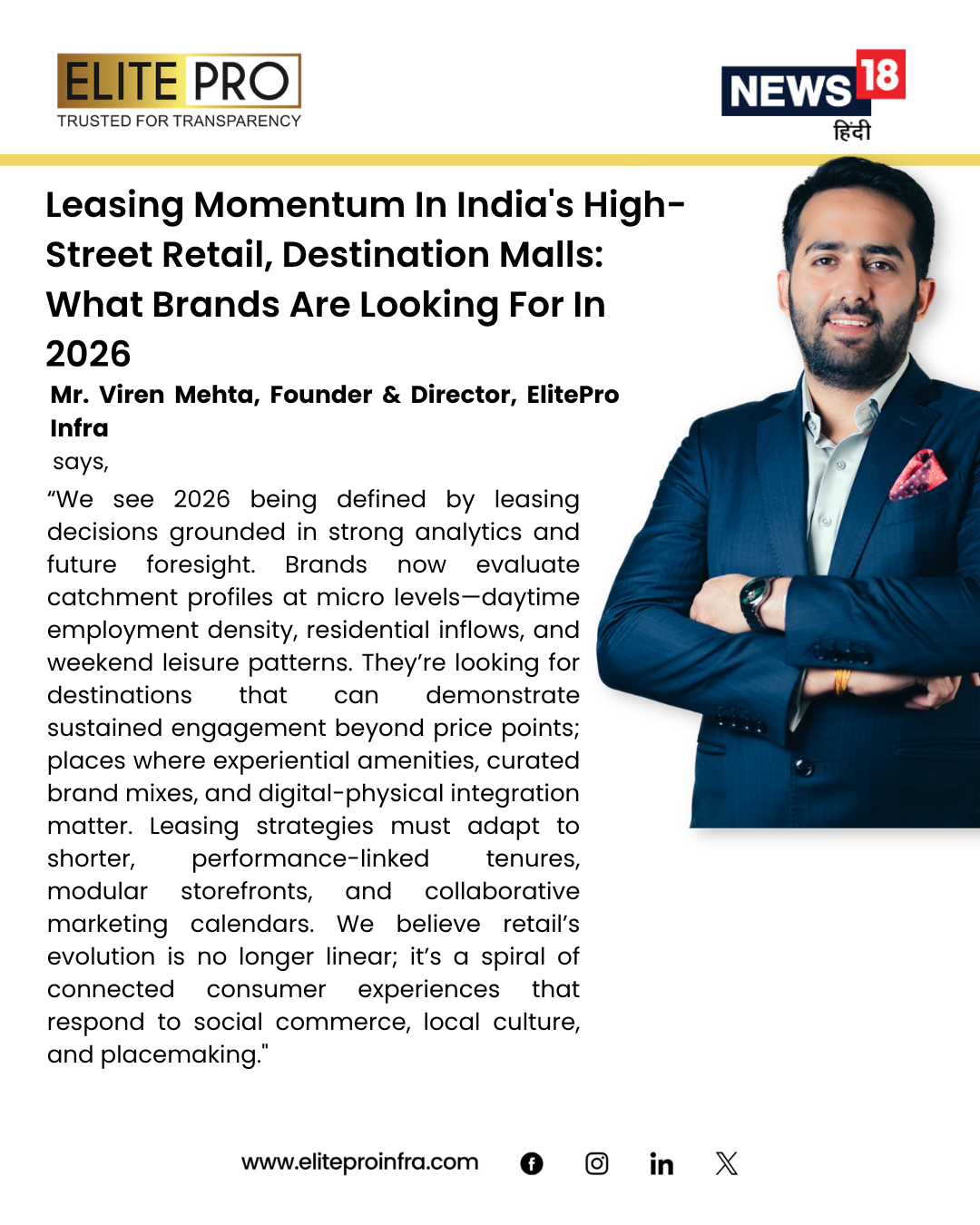
Viren Mehta, Founder and Director, Elite PRO Infra, says, “We see 2026 being defined by leasing decisions grounded in strong analytics and future foresight. Brands now evaluate catchment profiles at micro levels—daytime employment density, residential inflows, and weekend leisure patterns. They’re looking for destinations that can demonstrate sustained engagement beyond price points; places where experiential amenities, curated brand mixes, and digital-physical integration matter. Leasing strategies must adapt to shorter, performance-linked tenures, modular storefronts, and collaborative marketing calendars. We believe retail’s evolution is no longer linear; it’s a spiral of connected consumer experiences that respond to social commerce, local culture, and placemaking."
Overall, market sentiment around retail leasing remains firmly positive, supported by healthy demand, improving occupancies, and a clear shift towards quality assets. As formats continue to blur, the future points towards hybrid retail ecosystems that seamlessly integrate shopping, leisure, work, and social interaction.
Related PR & Media
.png)
.png)
.png)
.png)
.png)