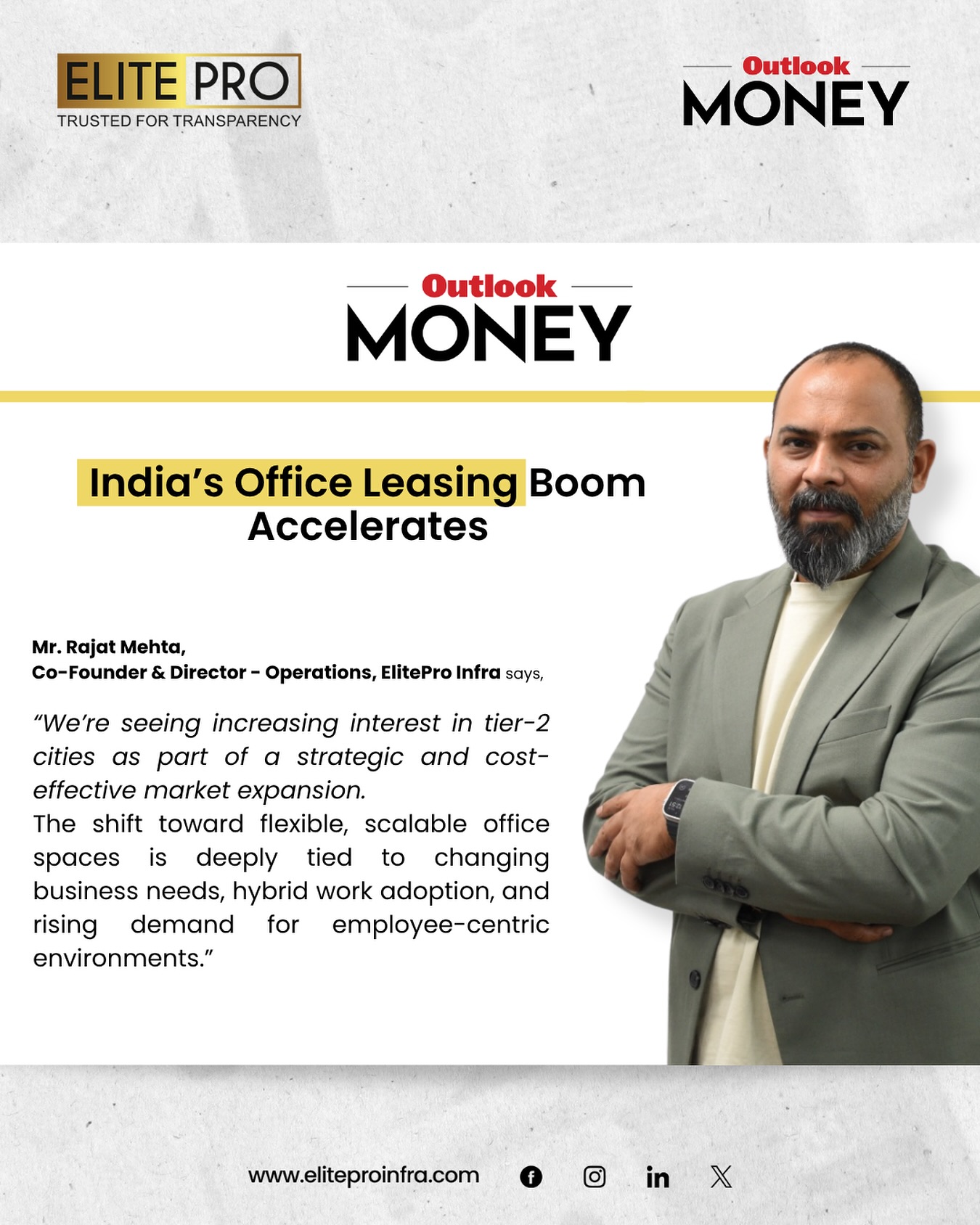
Rajat Mehta, co-founder & director, ElitePro Infra, underlines this decentralisation trend. “We’re seeing increasing interest in tier-2 cities as part of a strategic and cost-effective market expansion.” He notes that the shift toward flexible, scalable office spaces is deeply tied to changing business needs, hybrid work adoption, and rising demand for employee-centric environments.
He further adds that the growing preference for flexible and scalable office spaces is closely aligned with evolving business models. With hybrid work becoming the norm, organizations are prioritizing agile workspaces, satellite offices, and managed office solutions that can adapt to changing workforce dynamics. This has led to a surge in demand for co-working spaces, plug-and-play offices, and tech-enabled workplaces across emerging cities.
Another important driver behind this trend is the need for risk diversification. Companies are increasingly moving away from a single-city concentration strategy to a distributed portfolio approach, ensuring business continuity and operational flexibility.
At a macro level, India’s position in the global office market continues to strengthen.
“India's rapid GCC growth is cementing its status as a global innovation hub, with gross leasing expected to cross 90 mn. sq.ft. in 2025.”
FAQs: India’s Office Leasing Boom & Tier-2 City Growth
1. Why are Tier-2 cities like Indore gaining popularity for office leasing?
Tier-2 cities offer lower costs, improving infrastructure, and access to skilled talent, making them attractive for companies looking to expand efficiently.
2. How much cost advantage do Tier-2 cities provide?
Cities like Indore offer 30–40% lower operational costs compared to metro cities like Bengaluru and Pune.
3. What kind of companies are expanding into Tier-2 cities?
GCCs, IT-BPM firms, startups, and flex space operators are leading the expansion into these emerging markets.
4. What are the rental yields in cities like Indore?
Rental yields in prime areas of Indore typically range between 6–7%, with strong appreciation potential.
5. Is this shift to Tier-2 cities temporary or long-term?
This is a long-term structural shift, driven by cost optimization, decentralization, and evolving workplace strategies.
6. How is hybrid work influencing this trend?
Hybrid work is increasing demand for flexible, scalable, and satellite office spaces, which Tier-2 cities can provide at lower costs.

.png)
.png)
.png)
.png)
.png)